AILucidFlow · AI product design, ML systems
AI match analysis wrestlers can trust
Breaking down match film takes hours, and most wrestlers never do it. For my capstone in ELVTR’s Intro to AI Product Design course, I designed LucidFlow end to end: the ML pipeline, the product, and the feedback loops that let wrestlers and coaches correct the AI and make it smarter.
- Role
- Product designer, solo
- Context
- ELVTR capstone project
- Focus
- ML pipeline and AI UX
- Users
- Wrestlers, coaches, parents
- Challenge
- Turn hours of match film into insight athletes trust, knowing the model will sometimes be wrong.
- What I did
- Mapped the ML system first, then designed upload, AI transcripts, correction, scouting, and a move library.
- Outcome
- A complete concept where every human correction becomes training data.
AI-powered insights
Taking athletic analysis to new heights
See the big picture.
AI-generated feedback based on the strategies and tactics of the best in the world.


The problem
Film study is how serious wrestlers get better, but it’s slow. Someone has to watch a match, note every shot, scramble, and escape, then turn that into something useful for the next opponent. Most high school and college athletes don’t have a staff to do it, and coaches rarely have the time to do it for a whole roster.
AI can recognize patterns in video faster than a person can. The design problem was everything around the model: getting video in, showing what the AI saw, letting people fix it when it’s wrong, and turning raw detections into advice an athlete would actually act on.
- Who it’s forWrestlers preparing for specific opponents, coaches scouting, and parents who want to understand what they’re watching.
- The real jobNot “watch my match,” but “tell me how to beat this person.” That made head-to-head scouting the center of the product.
- The riskA confident, wrong analysis is worse than none. Trust had to be designed in from the start.
How I approached it
- 01FrameDefined the users, the core job, and where AI adds value versus where people must stay in charge.
- 02Map the systemDiagrammed the ML pipeline before any screens: models, data stores, and every point where a person steps in.
- 03Define the labelsBuilt the move taxonomy the model would learn, because the labels are the information architecture.
- 04Wireframe the flowsSketched upload, review, scouting, and the library directly on the system map.
- 05Design the productTook the flows to high fidelity and refined them as the patterns for correction and feedback became clear.
The system
I mapped the system before designing screens: which model does what, where people step in, and how their feedback flows back into training. Select a step to zoom into the map.
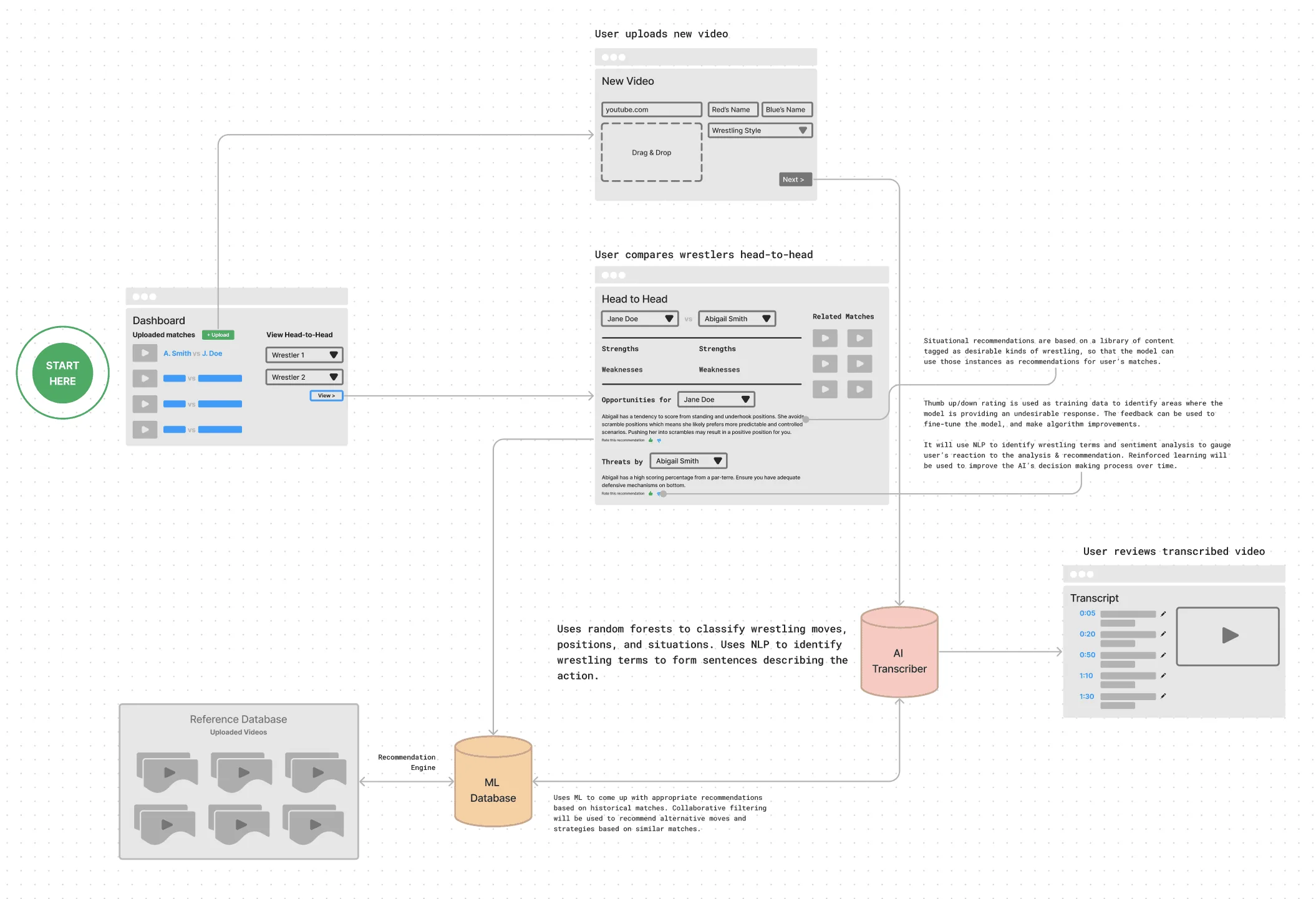
Three model types do different jobs. Random forests classify moves, positions, and situations from video. NLP turns those classifications into readable sentences and analyzes how people react to the advice. Collaborative filtering recommends moves and strategies based on similar matches in the reference library.
Designing the labels
A model can only learn the categories you give it, so the move taxonomy was a design decision, not an engineering detail. I organized moves the way coaches already talk about them, from broad to specific: position, then type, then technique.
| Level | Example | Why it matters |
|---|---|---|
| Position | Takedown | Lets coaches filter by phase of the match |
| Type | Leg attack | Groups techniques that share setups and defenses |
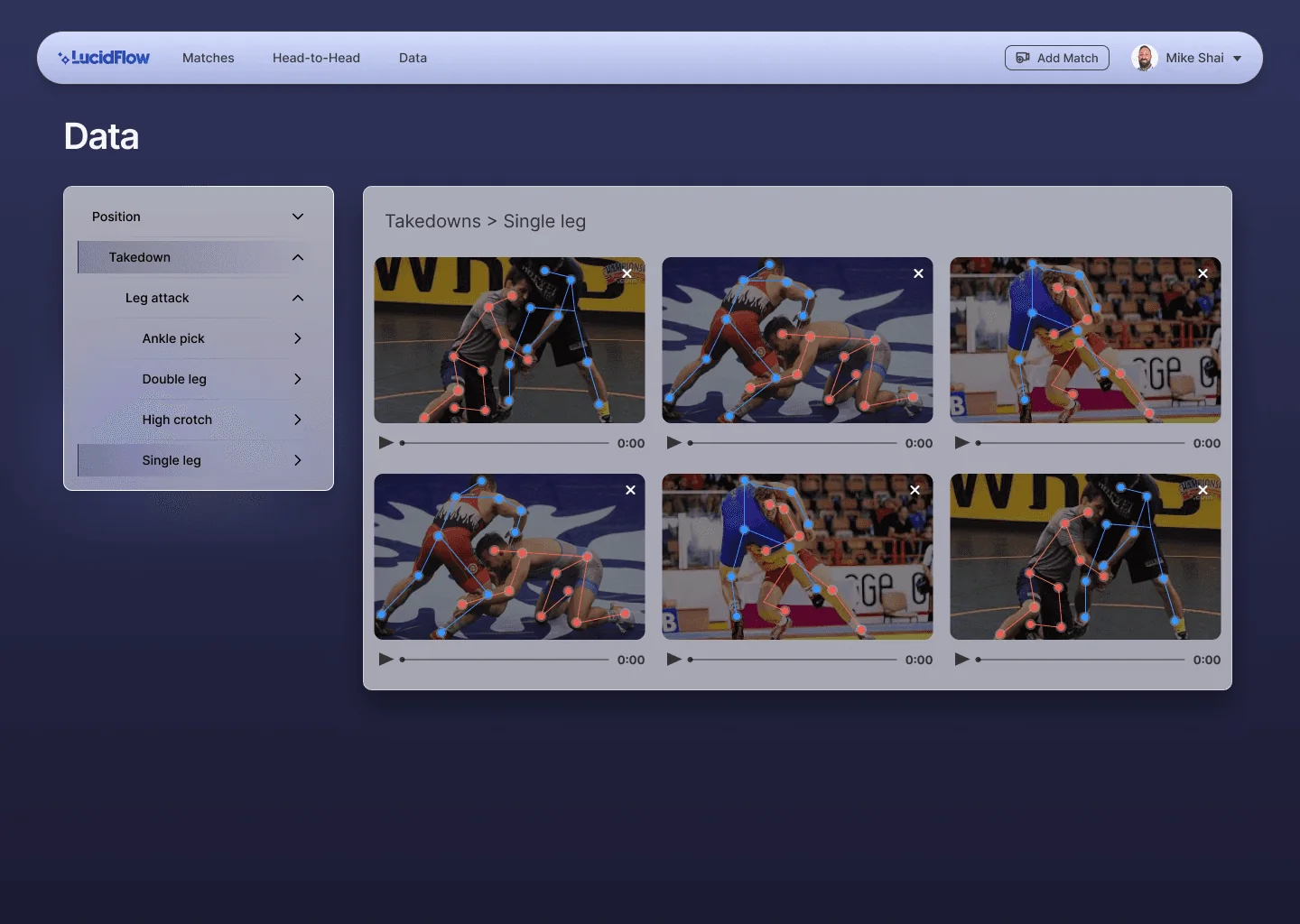
| Technique | Single leg, double leg, high crotch, ankle pick | The level the model classifies and athletes drill |
Because people can move a clip from one category to another, the taxonomy doubles as a correction tool. Every move is a new labeled example.
The product
- 01
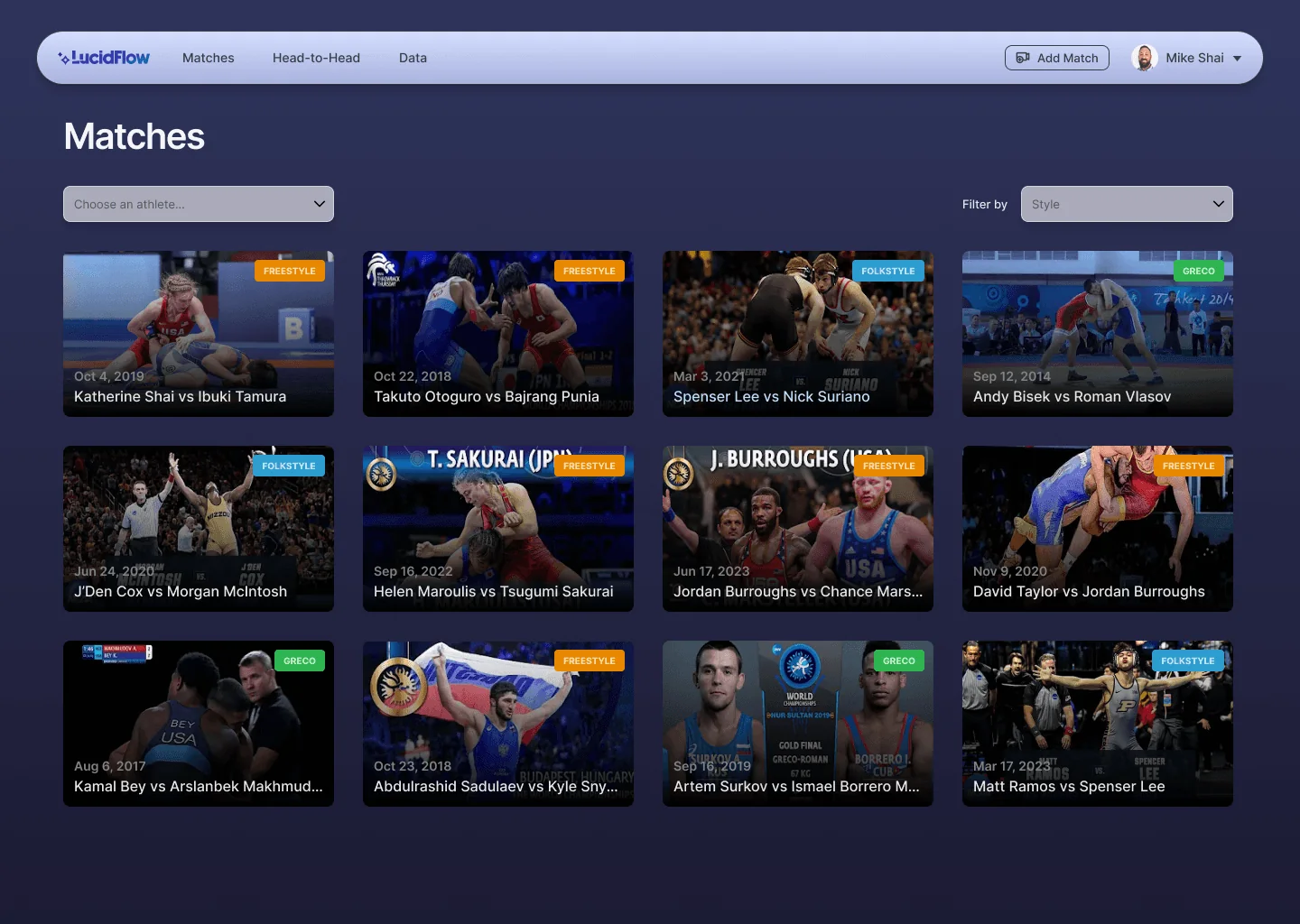
Every match in one place
The library holds every uploaded match. Filter by athlete or by style: freestyle, Greco, or folkstyle.
- 02
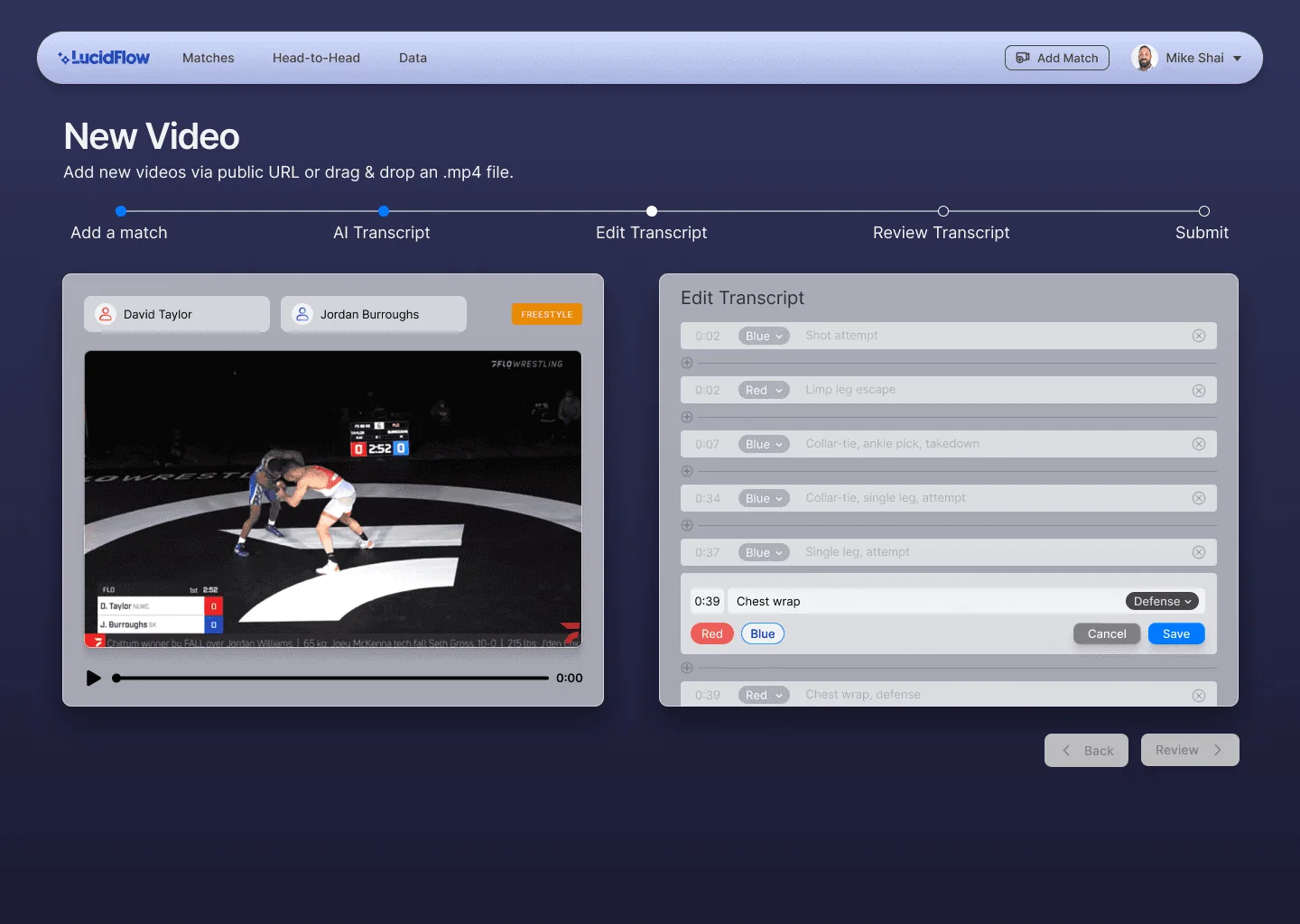
AI drafts, people decide
Add a match by link or file, and the AI drafts a move-by-move transcript. Before anything is saved, you review it and fix moves, sides, and positions in a five-step flow.
- 03
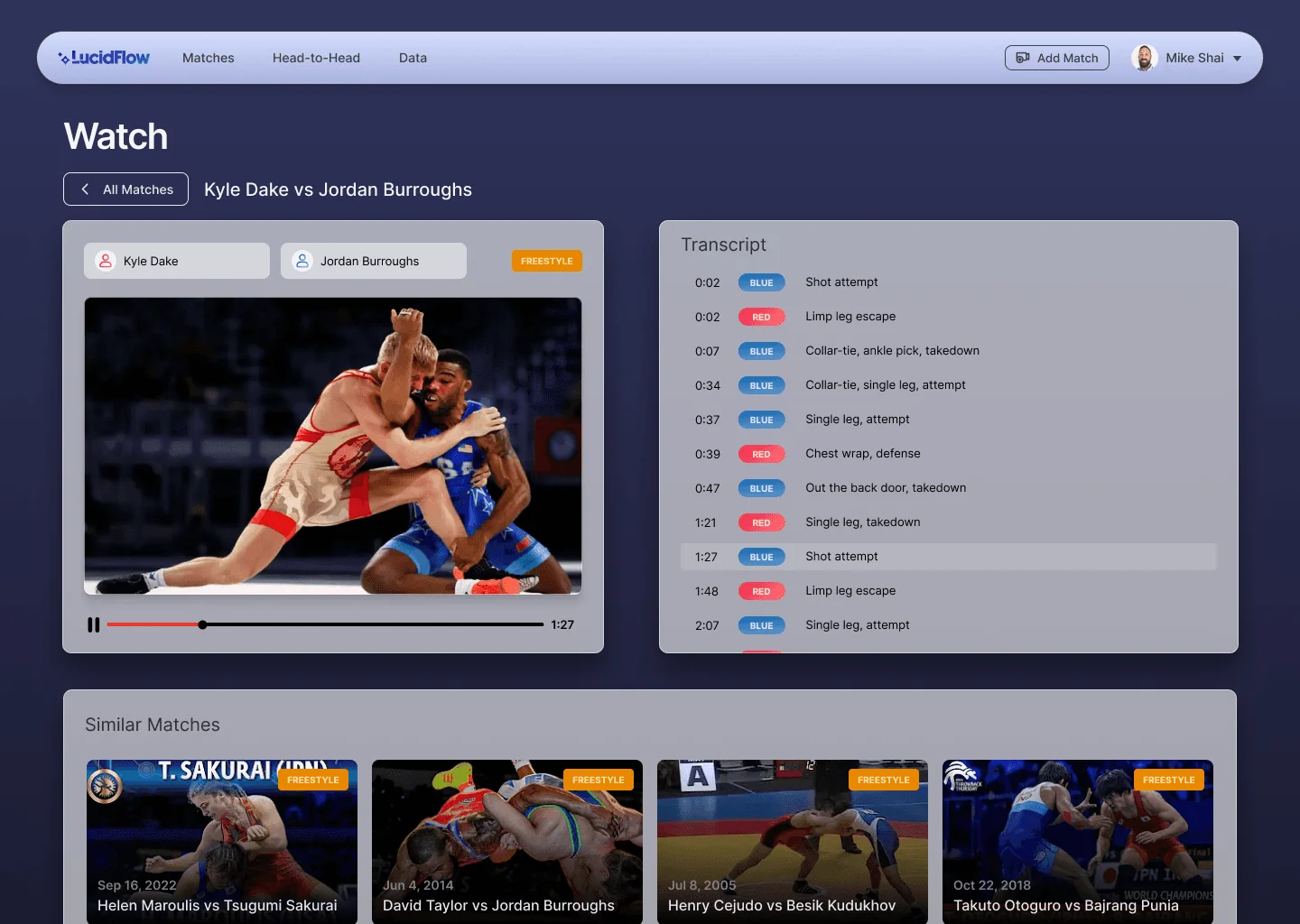
Watch with the transcript
The transcript stays in sync with the video, color-coded by wrestler. Click any moment to jump there. Similar matches appear below for study.
- 04
Head-to-head scouting
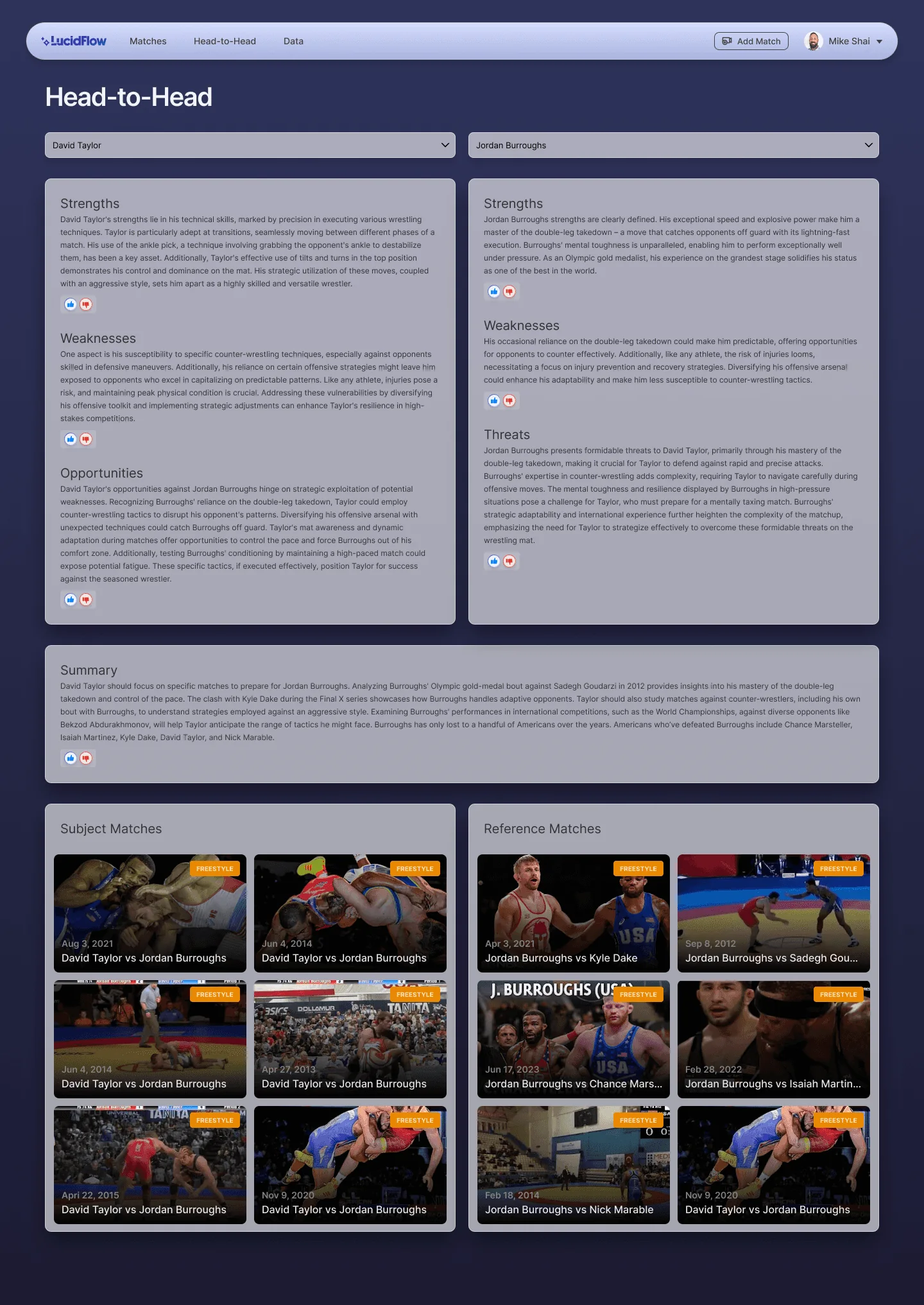
Pick two wrestlers to get strengths, weaknesses, opportunities, threats, and a summary of which matches to study. Every insight has a thumbs up or down.
- 05
A library the AI learns from
Clips are grouped by move, from takedown to leg attack to single leg, with pose overlays that show what the model saw. Moving a clip to the right category corrects the model.
Key decisions
Auto-publish the AI transcript so users get results instantly
Make the transcript a draft that people review in a five-step flow before saving
WhyWrong data poisons every insight built on it. A short review step protects scouting quality and turns each fix into training data.
A single overall analysis per wrestler
Head-to-head reports framed as strengths, weaknesses, opportunities, and threats for a specific matchup
WhyAthletes prepare for a person, not an average. Framing advice around the matchup makes it actionable.
Hide the reasoning to keep reports clean
Link every recommendation to the subject and reference matches behind it
WhyCoaches need to check the evidence. Showing sources turns a black box into a study plan.
Every insight can be rated
Thumbs up and down on each section of a report give the model a direct signal. Combined with sentiment analysis of how people react, the ratings feed fine-tuning and reinforcement learning, so the advice improves with use.
From map to product
The wireframes on the system map and the final screens differ in ways that show what I learned along the way.
- Dashboard became a library. The wireframe opened on a dashboard. The final product opens on a match library, because finding the right match is the first thing every user does.
- Editing moved earlier. The wireframe let people edit a transcript after the fact. The final flow builds review into upload itself: add a match, AI transcript, edit, review, submit.
- Related matches split in two. One list of related matches became subject matches and reference matches, separating the opponent’s history from examples of how others beat them.
What I’d do next
If LucidFlow moved beyond a concept, these are the questions I’d answer first:
- Measure trust, not just accuracy. Track how often users edit the transcript and rate insights down, alongside classification accuracy.
- Show confidence. Flag low-confidence classifications in the transcript so reviewers know where to look first.
- Test with coaches early. Put the head-to-head report in front of coaches before a real dual meet and see what they actually use.
The course
LucidFlow was my capstone for Intro to AI Product Design from ELVTR, a live course for product designers. It covered ML fundamentals for designers, UI patterns for AI, designing for bias, privacy, and inclusion, metrics for AI products, and prototyping with AI tools. Those ideas carried directly into the AI products I’ve built since.